My Academic Journey
- BS/MS: My academic journey began with a focus on occupational safety during my undergraduate studies [1–2], later narrowed to evaluating OHSMS performance using fuzzy mathematics [3–11].
- IT Industry: I went to the IT industry after graduation, serving as a safety professional and then senior management roles, also as a standard expert in IEC/TC111, ITU/SG5, and TC297/SC1.
- MBA: I finished an MBA at Peking University during my industry working period.
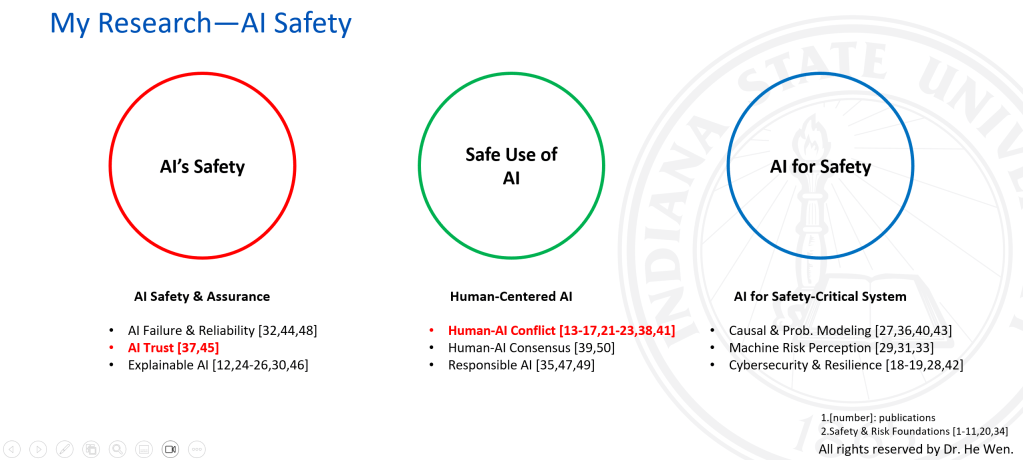
- PhD: During COVID, I moved to Canada for my PhD, focusing on human–AI conflict [12–17,21-23], cybersecurity-induced safety risks [18-19], and health-related AI applications [20].
- Postdoc: During postdoc, I stressed explainable AI [24-27] and LLMs for safety [28-29].
- TTAP: Now I continue my research as TTAP on AI safety in USA, focusing on machine risk perception, human-AI trust calibration, and LLMs in engineering applications [30-].
[48] Wen, H., & Sajid, Z. (2026). Emerging Risks and Failure Boundaries of Applying Large Language Models to Process Control. Digital Chemical Engineering, 100334. https://doi.org/10.1016/J.DCHE.2026.100334
[47] Wen, H. (2026). Innovation in enhancing safety culture: Artificial intelligence (AI), automation and digitalization. In Methods in Chemical Process Safety (Vol. 10). Elsevier. https://doi.org/10.1016/BS.MCPS.2026.07.005
[46] Wen, H., & Amin, Md. T. (2026). Interpretable Deep Learning for Risk Representation: A Risk Model for Construction Safety. ASCE-ASME Journal of Risk and Uncertainty in Engineering Systems, Part A: Civil Engineering, 12(4), 04026060. https://doi.org/10.1061/AJRUA6.RUENG-1933
[45] Wen, H., & Khan, F. (2026). A Probabilistic Framework for Quantifying AI Trust Under Operational Uncertainty in Process Systems. Process Safety and Environmental Protection, 109419. https://doi.org/10.1016/J.PSEP.2026.109419
[44] Wen, H., Roberts, J., Zaidi, A., & McLeod, A. (2026). An experiment of using a large language model to control a water tank system. Computers & Chemical Engineering, 211, 109656. https://doi.org/10.1016/J.COMPCHEMENG.2026.109656
[43] Wen, H. & Khan, F. (2026). Precursor-based multi-class Bayesian meta-learning on rare event prediction for process systems. Computers & Chemical Engineering, 211, 109687. https://doi.org/10.1016/J.COMPCHEMENG.2026.109687
[42] Amin, M. T., Wen, H., Arunthavanathan, R., & Pasman, H. (2026). How does process safety benefit from AI? An overview of recent progress. In Artificial Intelligence in Safety Science and Engineering (pp. 11–45). Elsevier. https://doi.org/10.1016/B978-0-443-36342-9.00006-2
[41] Wen, H. (2026). Risk assessment of human-AI conflict. In Artificial Intelligence in Safety Science and Engineering (pp. 101–118). Elsevier. https://doi.org/10.1016/B978-0-443-36342-9.00011-6
[40] Wen, H. (2026). Toward Machine Risk Perception: Integrating Trust Calibration and Precursor-Based Risk Estimation for Humanoid. 2026 International Manufacturing Science and Engineering Conference (MSEC2026). https://arxiv.org/pdf/2606.20748
[39] Brown, L. R., Wen, H.*, Jaime, C. M., Perry, A., & Bedwell, W. (2026, June 22). Using the Delphi Method to Identify Causes of High Suicide Rates among Construction Workers. 2026 ASEE Annual Conference & Exposition. https://nemo.asee.org/public/conferences/374/papers/50216/view
[38] Wen, H. (2026). Human-Humanoid Collaboration and Ergonomic Risk: An Anthropometric Perspective. In E. Gentry, F. Ju, & X. Liu (Eds.), Proceedings of the IISE Annual Conference & Expo 2026. https://arxiv.org/abs/2607.24746
[37] Wen, H. & Mounir, A. (2026). Mathematical Modeling of Trust Calibration for Human–Automation Safety. SAE Technical Paper, (01), 530. https://doi.org/10.4271/2026-01-0530
[36] Wen, H. (2026). A new perspective on precursors and rare events from a systematic review. Journal of Loss Prevention in the Process Industries, 99, 105785. https://doi.org/10.1016/j.jlp.2025.105785
[35] Liu, Z., Park, J., Wang, M., & Wen, H.* (2026). Insuring Algorithmic Operations: Liability Risk, Pricing, and Risk Control. Risks 2026, Vol. 14, Page 26, 14(2), 26. https://doi.org/10.3390/RISKS14020026 [Featured Article, Editor’s Article, Corresponding Author]
[34] Wen, H. (2025). Age Dependence of Occupational Fatality Risk: Is It A U-curve? SSRN. https://doi.org/10.2139/ssrn.5864642
[33] Wen, H., Parsaee, M., & Sajid, Z. (2025). Modeling Dynamic Risk Perception Using Large Language Model (LLM) Agents. AI, 6(11). https://doi.org/10.3390/ai6110296 [Editor’s Article]
[32] Wen, H., Roberts, J., Zaidi, A., & Moayed, F. (2025). Inherent Risk of Applying Large Language Model in Process Control System: A Perspective. Proceedings, 2025 Mary Kay O’Connor Safety & Risk Conference. https://doi.org/10.2139/ssrn.5759685
[31] Wen, H., Sajid, Z., & Arunthavanathan, R. (2025). Risk Perception in Complex Systems: A Comparative Analysis of Process Control and Autonomous Vehicle Failures. AI, 6(8). https://doi.org/10.3390/ai6080164 [Editor’s Article]
[30] Wen, H., & Hu, P. (2025). Architectural Gaps in Generative AI: Quantifying Cognitive Risks for Safety Applications. AI, 6(7). https://doi.org/10.3390/ai6070138 [Editor’s Article]
[29] Wen, H., Abourizk, S., & Mohamed, Y. (2025). Using Large Language Models to Identify Project Risks for Sustainable Operations. CIB Conferences, 1. https://doi.org/10.7771/3067-4883.1757
[28] Wen, H., Simaan, A., & Yasser, M. (2025). Gap Analysis of Digitalization Levels in Construction and Manufacturing: A Comparative Study of Construction 4.0 and Industry 4.0. Journal of Construction Engineering and Management, 151(3), 04025001. https://doi.org/10.1061/JCEMD4.COENG-14896 [Featured Article]
[27] Wen, H., Khan, F., AbouRizk, S., & Fu, G. (2024). Understanding of causality and its mathematical representation in accident modeling. Reliability Engineering & System Safety, 250, 110283. https://doi.org/10.1016/j.ress.2024.110283
[26] Wen, H. (2024a). A Model of Proactive Safety Based on Knowledge Graph. ArXiv Preprint. https://doi.org/10.48550/arXiv.2407.15127
[25] Wen, H., AbouRizk, S., Mohamed, Y., & Huang, R. (2024). A Framework of Project Risk Simulation with Event Knowledge Graph. 2024 Winter Simulation Conference. https://doi.org/10.1109/WSC63780.2024.10838960
[24] Wen, H., AbouRizk, S., & Mohamed, Y. (2024). A Data-Driven Accident Model (DAM): Holistic Risk Simulation Using Explainable Artificial Intelligence. Available at SSRN 4678045.
[23] Wen, H. (2024b). Human-AI collaboration for enhanced safety. In Methods in Chemical Process Safety. Elsevier. https://doi.org/10.1016/bs.mcps.2024.07.001
[22] Wen, H., & AbouRizk, S. (2024, June 3). Interpretation Conflict in Helmet Recognition under Adversarial Attack. https://doi.org/10.22260/ISARC2024/0082
[21] Wen, H., & Khan, F. (2024). A risk-based model for human-artificial intelligence conflict resolution in process systems. Digital Chemical Engineering, 13, 100194. https://doi.org/10.1016/j.dche.2024.100194
[20] Asgary, A., Aarabi, M., Dixit, S., Wen, H., Ahmed, M., & Wu, J. (2024). A Survey of the Use of Modeling, Simulation, Visualization, and Mapping in Public Health Emergency Operations Centers during the COVID-19 Pandemic. International Journal of Environmental Research and Public Health, 21(3). https://doi.org/10.3390/ijerph21030295
[19] Wen, H. (2023b). Vulnerability Assessment of Industrial Control System with an Improved CVSS. ArXiv Preprint. https://doi.org/10.48550/arXiv.2306.08631
[18] Wen, H., & Khan, F. (2023). Cybersecurity and process safety synergy: An analytical exploration of cyberattack-induced incidents. Canadian Journal of Chemical Engineering. https://doi.org/10.1002/cjce.25119
[17] Wen, H. (2023a). The Digital Divide in Process Safety: Quantitative Risk Analysis of Human-AI Collaboration. ArXiv Preprint. https://doi.org/10.48550/arXiv.2305.17873
[16] Wen, H., Amin, Md. T., Khan, F., Ahmed, S., Imtiaz, S., & Pistikopoulos, E. (2023). Assessment of Situation Awareness Conflict Risk between Human and AI in Process System Operation. Industrial & Engineering Chemistry Research, 62(9), 4028–4038. https://doi.org/10.1021/acs.iecr.2c04310
[15] Wen, H., Khan, F., Ahmed, S., Imtiaz, S., & Pistikopoulos, S. (2023). Risk assessment of human-automation conflict under cyberattacks in process systems. Computers & Chemical Engineering, 172, 108175. https://doi.org/10.1016/j.compchemeng.2023.108175
[14] Wen, H. (2022). Alert of the Second Decision-maker: An Introduction to Human-AI Conflict. Proceedings, 2022 Mary Kay O’Connor Safety & Risk Conference. https://doi.org/10.48550/arXiv.2305.16477
[13] Wen, H., Amin, Md. T., Khan, F., Ahmed, S., Imtiaz, S., & Pistikopoulos, S. (2022). A methodology to assess human-automated system conflict from safety perspective. Computers & Chemical Engineering, 165, 107939. https://doi.org/10.1016/j.compchemeng.2022.107939
[12] Wen, H., Khan, F., Amin, Md. T., & Halim, S. Z. (2022). Myths and misconceptions of data-driven methods: Applications to process safety analysis. Computers and Chemical Engineering, 158, 107639. https://doi.org/10.1016/j.compchemeng.2021.107639
[11] Wen, H., Chen, Q, Chen, B. Research on the determination of weights of OHSMS performance evaluation indicators. Industrial Safety and Environmental Protection 2012, 38 (11), 14–16.
[10] Wen, H., Chen, Q, Chen, B. Research on OHSMS performance evaluation based on trapezoidal fuzzy numbers. Journal of Safety Science and Technology 2012, 8 (6), 210–215.
[9] Chen, Q, Wen, H.*, Chen, B. Research on the maturity evaluation of HSE management system. Journal of Safety Science and Technology 2012, 8 (2), 123–128. (Corresponding Author)
[8] Chen, Q, Wen, H.*, Chen, B. Performance evaluation of occupational health and safety management system based on binary semantics. Journal of China Safety Science 2011, 21 (10), 156. (Corresponding Author)
[7] Wen, H., Chen, Q, Chen, B. Research on the maturity evaluation of occupational health and safety management system. Safety 2012, 33 (4), 29–32.
[6] Wen, H. Fall prevention campaign in the US construction industry. Modern Occupational Safety 2012, No. 10, 96–97.
[5] Wen, H. Overview of the UK HSE Industry Association. Modern Occupational Safety 2012, No. 9, 96–97.
[4] Wen, H., Chen, Q. The best companies for safety management in the United States in 2011 (Part 2). Modern Occupational Safety 2012, No. 6, 92–95.
[3] Wen, H., Chen, Q. The best companies for safety management in the United States in 2011 (Part 1). Modern Occupational Safety 2012, No. 5, 90–93.
[2] An, H, Wen, H.* On fulfilling the functions of trade unions and maintaining public safety. Chinese Workers’ Movement 2010, No. 1, 47–48. (Corresponding Author)
[1] An, H, Wen, H.* Research on accident prevention management based on analytic hierarchy process. The 7th China Management Science and Engineering Forum, 2009. (Corresponding Author)
* Corresponding Author
[No.] Entries are listed in reverse chronological order by publication date.

